Relationship intelligence, in preview

Remember everything about everyone.

Tribe keeps what you know about the people you work with in one place: how you met, what they like to talk about, what to steer around. It is built and tested, and not running in production yet.

Illustration: a wide hall hung with hundreds of small blank paper lanterns joined by fine threads, one lantern glowing soft magenta.
Features

A contact book that remembers the details

Tribe is built around a simple idea from Harvey Mackay: relationships are built on specifics, so write the specifics down. The web app holds the profiles, the timeline, the groups, and search; an API and 41 agent tools do the rest; and the other fleet tools ask Tribe who someone is.

What you know about each person

01

Eleven categories

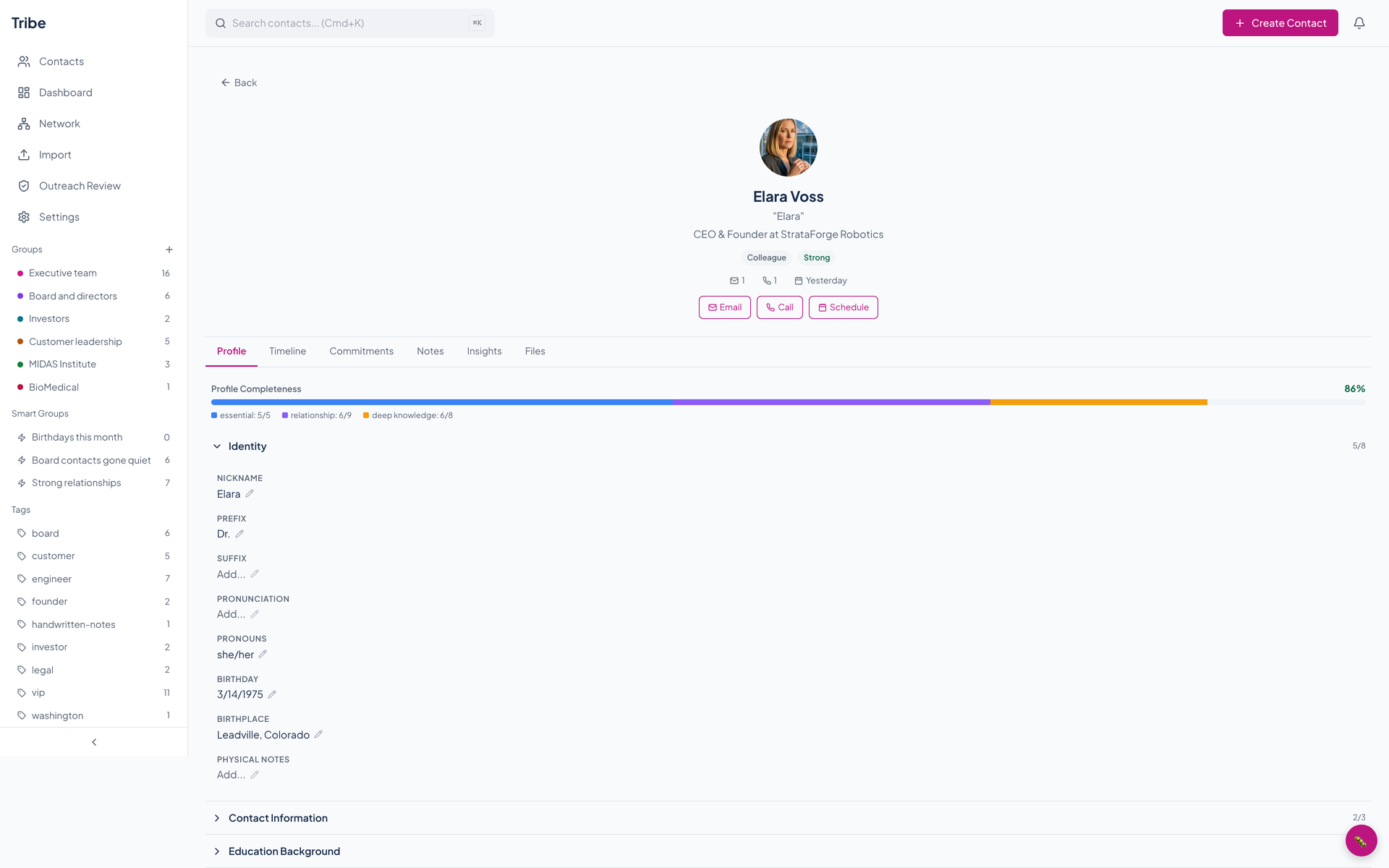
Identity, contact information, education, military service, family, career, interests, social life, drinking and smoking, personality and goals, and the relationship itself. Open one at a time, and click any field to edit it in place.

02

A completeness score

Twenty-two profile fields in three tiers (essentials 40 percent, relationship 35, deeper knowledge 25) give each person a score, with a count of what is filled in for each tier.

03

A privacy shield

Politics, religion, drinking, smoking, and health notes are stored encrypted with AES-256-GCM and sit behind a Reveal button on screen until you ask to see them.

04

Children, school, work, and service

Children (with their schooling and interests), schools, jobs, and military service are entries you add and remove on the profile, not one long text box.

Who they are to you, and how it is going

05

A timeline

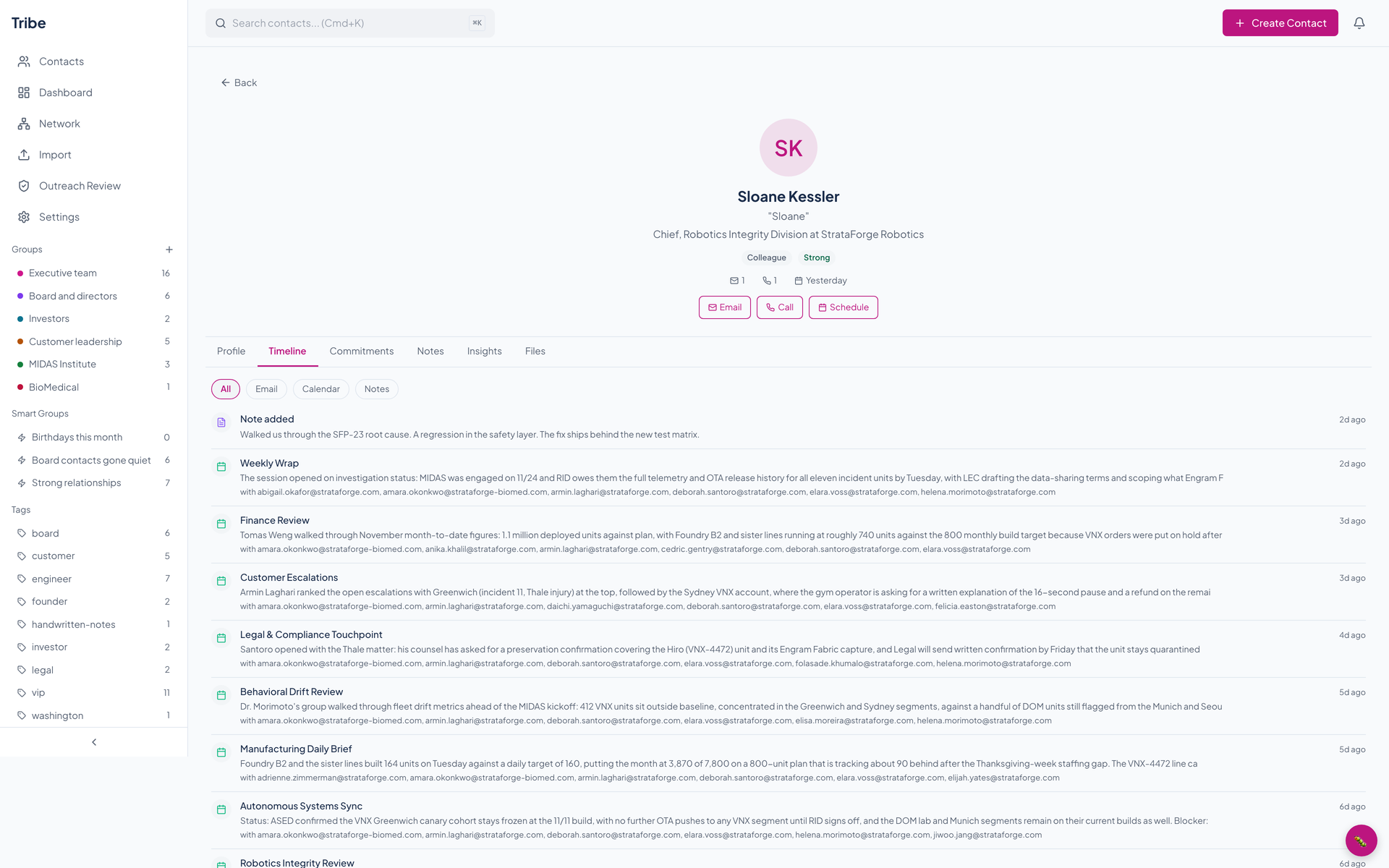
Your notes and the email and meeting entries Tribe holds for a person, newest first, filtered by email, calendar, or notes.

06

Notes you can pin

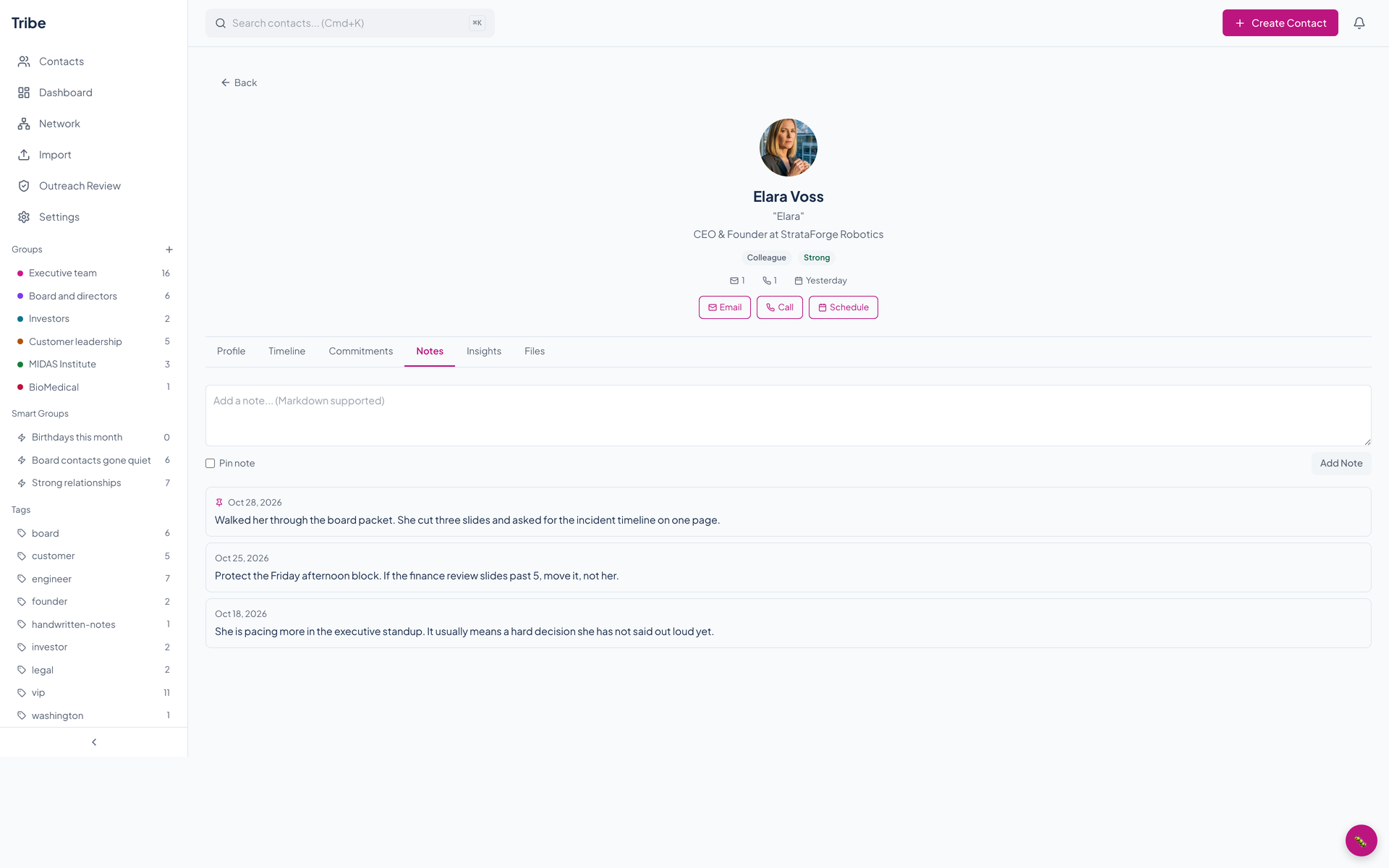
Write a note on the Notes tab, pin the ones that matter, and read them newest first after the pinned ones.

07

Groups and tags

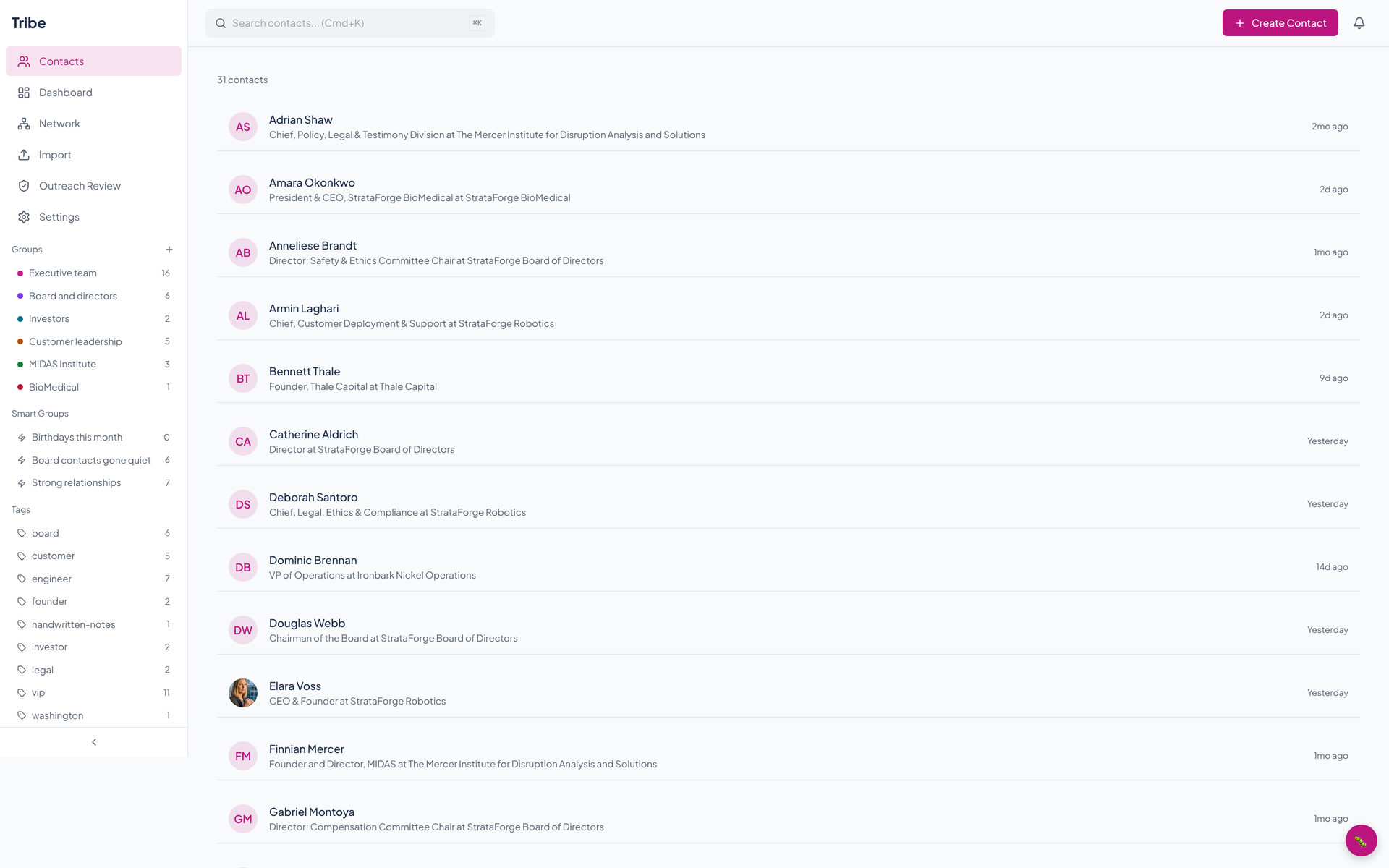
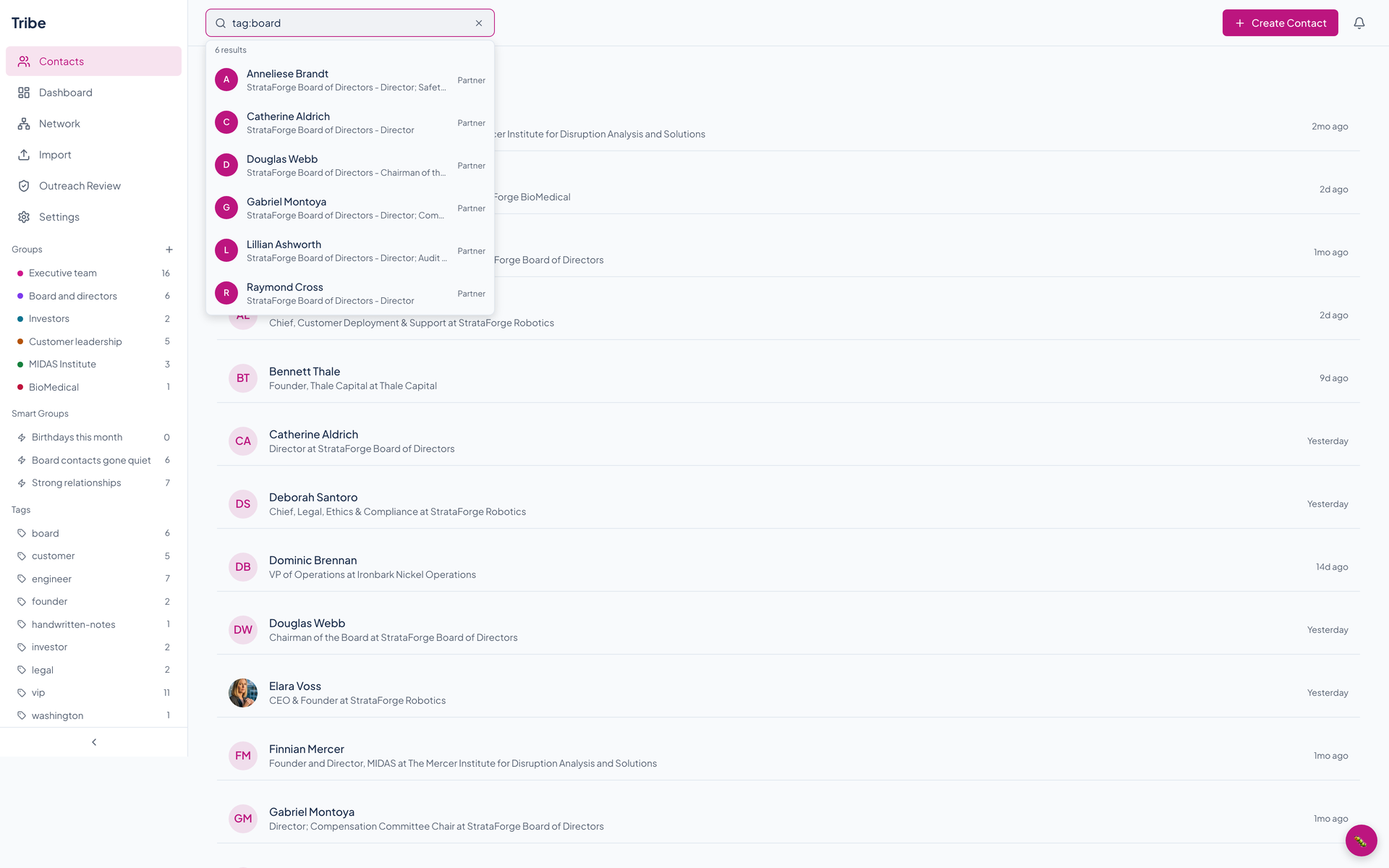
Groups (the demo has executive team, board, investors, and more) and tags with counts sit in the sidebar. To list only those people today, search for tag:board instead.

08

Search with operators

Press Control or Command plus K and type a name, or add operators such as tag:, company:, strength:, completeness:, and last_contact:. Ten operators in all.

09

A network graph

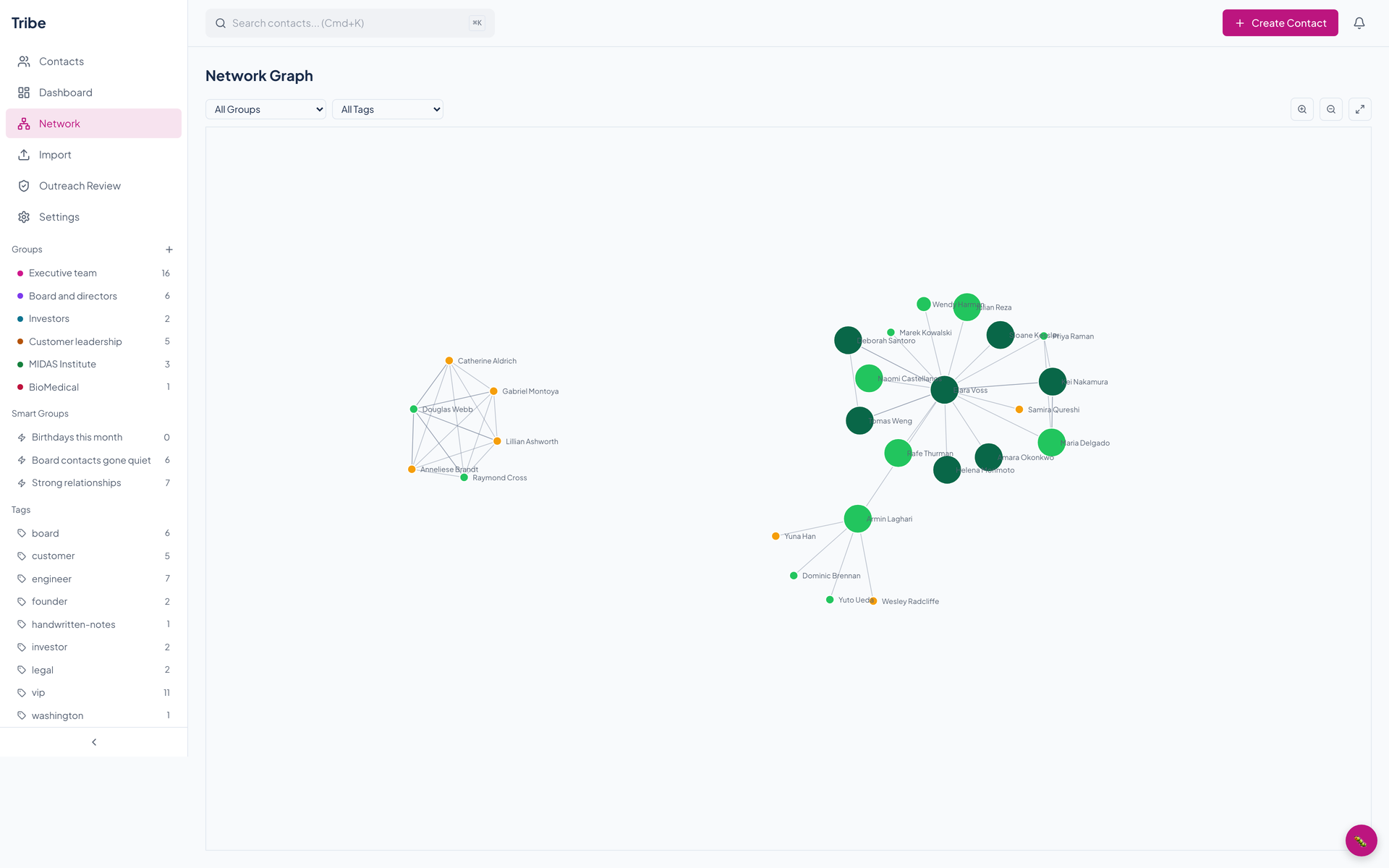
A force-directed map of your contacts, joined by shared meetings, email threads, introductions, company, and group. Zoom, pan, and filter by group or tag.

10

A dashboard

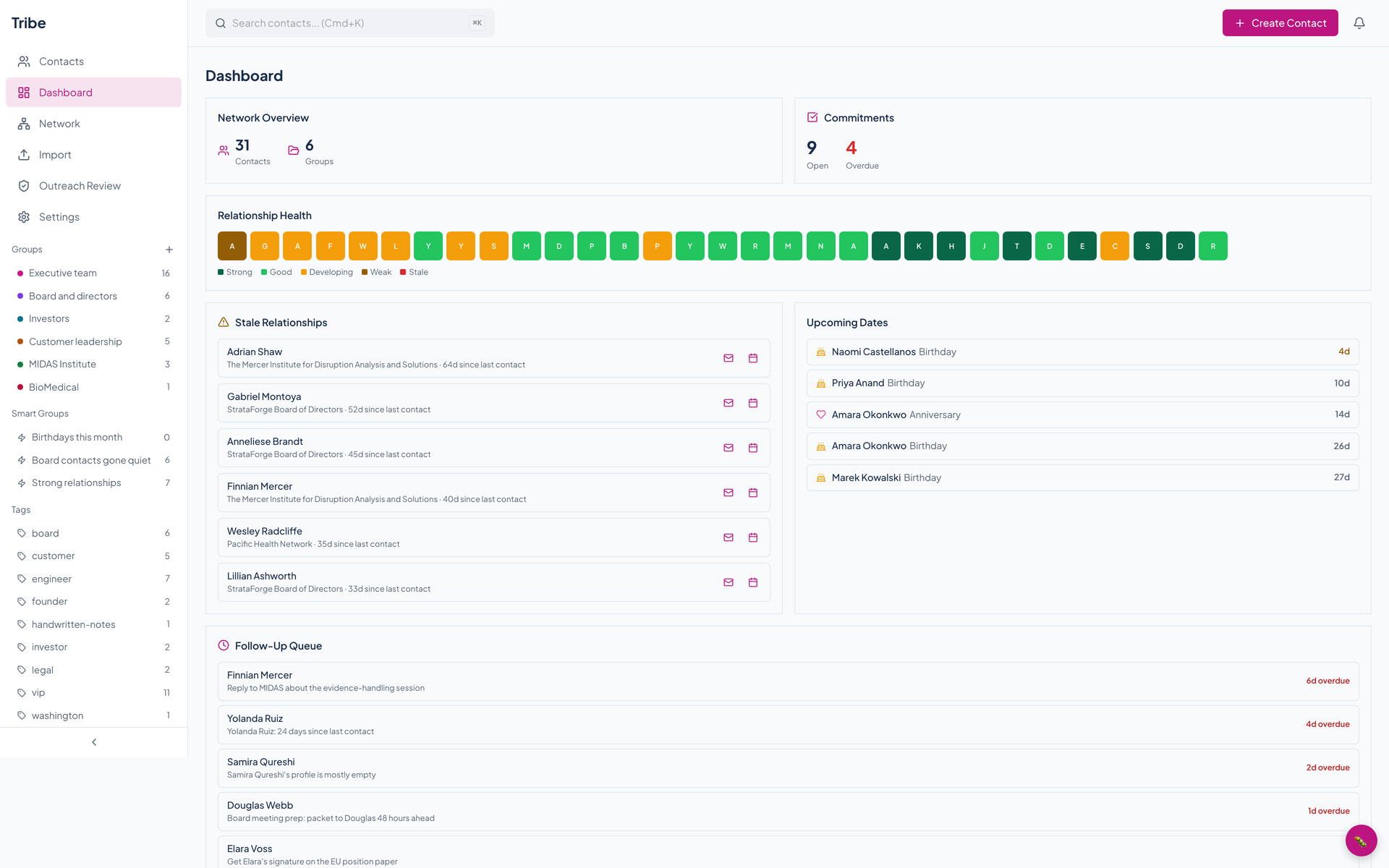
A health tile for every contact, the relationships that have gone longest without contact, birthdays and anniversaries coming up, and a count of open and overdue follow-ups.

Help for the next conversation, and for the other tools

11

Conversation starters

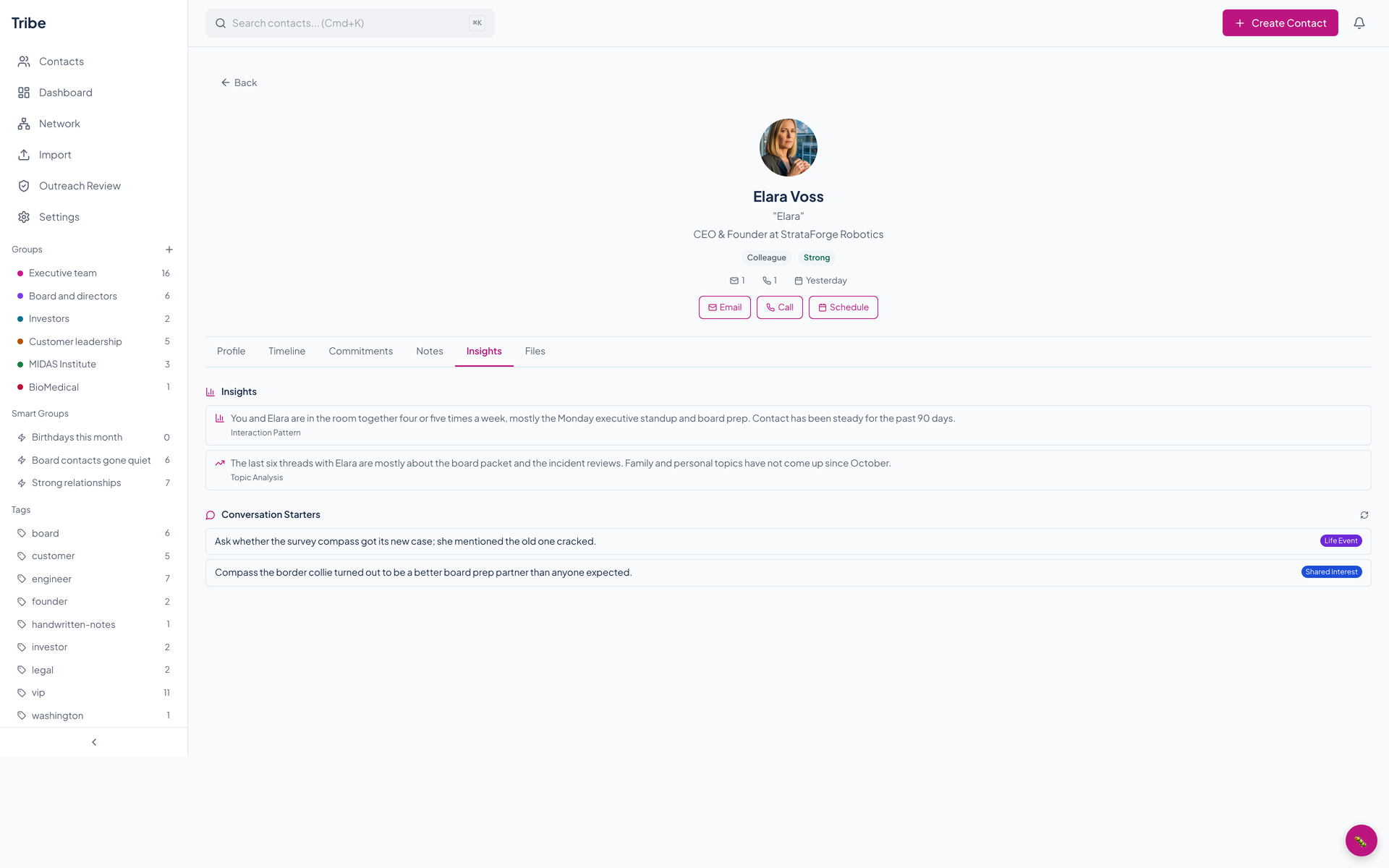
On a profile's Insights tab, Tribe asks a hosted language model for five things to raise, based on interests, family, and what you last talked about, and keeps them for a week.

12

Agent tools

41 tools let a coding or planning agent look people up, add notes, run searches, read the dashboard, import and export, and work the marketing outreach review.

13

The fleet's contact authority

Courier, Slate, Envoy, Beacon, and Chirp ask Tribe who someone is through service-token endpoints, so a contact lives in one place. Cadence's outreach bookings carry a Tribe contact ID.

14

Import from files

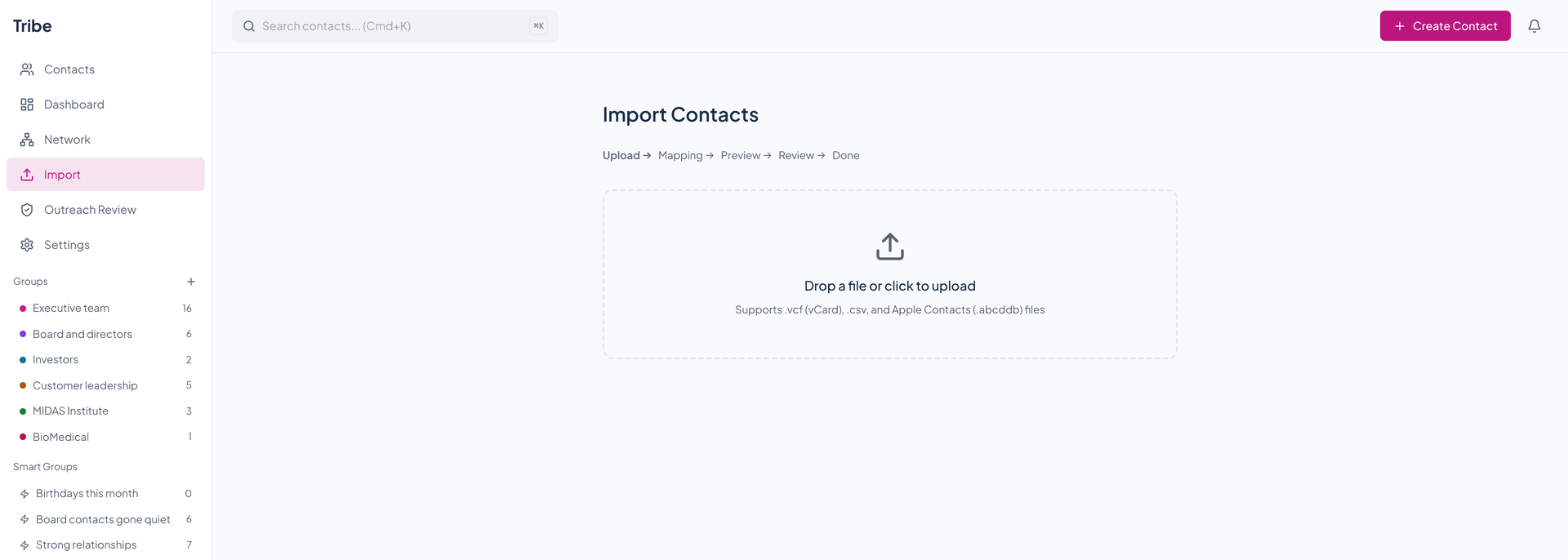
vCard, CSV with column mapping, and Apple Contacts files. A contact whose email matches an existing one is skipped and listed.

15

Outreach review

For Beacon's marketing outreach: a gated workspace for deciding who a creator is and what each contact has agreed to, with proof for every change.

Screens

See it in light and dark

Real captures of the running tool, with fictional StrataForge Robotics data. They follow your theme.

How it works

From a name to a relationship

  1. Add

    Create a contact with a name and a few basics, or import a vCard, CSV, or Apple Contacts file. A contact whose email matches one you already have is skipped and listed.

  2. Fill in

    Open the profile and add what you know, one category at a time. The completeness score shows what is still blank.

  3. Keep up

    Write notes, group and tag people, and watch the dashboard for the people you have not talked to in a while.

  4. Use it

    Search before a call, ask for conversation starters, or let another fleet tool or an agent look the person up.

Accessibility

Built so everyone can use Tribe.

Tribe is a web app, and this is what its code and tests show today. It has a skip link, labeled search and filters, keyboard-operable contact rows, and no horizontal overflow at 375 pixels. A real-browser axe-core scan of ten pages in both themes at two widths first found serious problems (low-contrast text, nested buttons, unnamed buttons, names that dropped their visible text); they were fixed the same day and the rescan reports no violations. Automated scans cannot judge keyboard or screen-reader use, and the app has not been tested with a screen reader. We do not claim a conformance level for the app.

  • Partly supported

    Keyboard operation

    A skip link jumps to the main content. Control or Command plus K focuses the contact search. Contact rows in the list take Tab focus and open with Enter, the tiles in the relationship health strip open with Enter or Space, and the profile tabs, buttons, and form controls are real buttons and fields. The network graph is a single labeled image, so its individual contacts cannot be reached from the keyboard. Nobody has walked every flow with only a keyboard.

  • Partly supported

    Screen reader landmarks and labels

    The page has a skip link, labeled search and filter controls, and an image label on the network graph. An automated axe-core scan of the whole app and of the contact list, dashboard, network, settings, import, and outreach review routes finds no violations in jsdom, and the real-browser scan, after fixes, finds none either. The profile's tabs are plain buttons without tab roles, so they do not announce which tab is selected. Tribe has not been tested with VoiceOver, NVDA, or any other screen reader.

  • Partly supported

    Contrast in light and dark

    Tribe's magenta accent measures 5.91 to 1 against white in light mode and 6.69 to 1 against the dark card color in dark mode, both above 4.5 to 1. As small text on the design system's shaded surfaces the kit measured the accent at 4.34 to 1, so this site's links use a slightly darker shade. The rest of the palette comes from the Renkara design system and has not been measured in the app, and the app sets some small text, such as a count beside a group name, in lighter tints that have not been measured. The jsdom scan does not compute contrast. The real-browser scan did, and it found low-contrast text in the dashboard's follow-up queue in dark mode.

  • Partly supported

    Reduced motion

    The design system's global stylesheet shortens every animation and transition to almost nothing when the system asks for reduced motion, and the outreach review page has its own reduced-motion rule. This was read from the stylesheets and not checked in a browser with the setting turned on.

  • Not yet tested

    Text resize and zoom

    Nobody has tested Tribe at larger text sizes or browser zoom. Much of the app is styled with fixed small sizes, so large text may crowd or clip.

  • Partly supported

    Mobile and touch

    Below 768 pixels the sidebar becomes a menu behind a button and closes when you pick a page. The real-browser scan loaded 10 pages at 375 pixels in both themes and none overflowed sideways. Nobody has used the app on a phone or checked that each page is comfortable there, and the profile's tab row scrolls sideways by design.

Tech specs

Under the hood

Tribe technical specification
Backend
  • FastAPI on Python 3.12, with async SQLAlchemy 2 and Alembic migrations (5 so far)
  • PostgreSQL for contacts, notes, groups, and the timeline cache; search is substring matching, not Postgres full-text
  • Valkey for caching and the job queue, with Celery workers and a Celery Beat schedule
  • REST under /api/v1 and a WebSocket that pushes changes to the open app
Frontend
  • React 19, Vite, and TypeScript, with Zustand for state
  • The Renkara design system's tokens and Tailwind, with Plus Jakarta Sans and Fira Code, and icons from Lucide
  • D3 for the network graph and Recharts for dashboard charts
  • Light and dark themes, and a menu in place of the sidebar on narrow screens
Data and privacy
  • Eleven sensitive fields (political views, religion, drinking, smoking, and health notes) are stored encrypted with AES-256-GCM
  • Contacts are soft-deleted and can be restored through the API
  • Every record belongs to one user; the fleet endpoints act for the user a service token names
AI
  • Conversation starters from Mercury 3 (Inception Labs), asked for on demand
  • Meeting prep briefings from Claude Sonnet 5.5 (Anthropic), through the API and agent tools
  • Neither runs without a model key, and no scheduled AI job is switched on yet
Agents and API
  • 41 agent tools over stdio, relayed through Roost: 29 for contacts, notes, groups, dashboards, and import and export, and 12 for creator and outreach review
  • Fleet endpoints for autocomplete, lookup by email or phone, and a contact card, behind service tokens
  • vCard and CSV import and export
Quality
  • 719 backend test functions and 331 frontend test cases, counted by search on 10/29/2026
  • An automated axe-core scan of the app and six pages (see Accessibility)
Stands in for

Harvey Mackay's paper Customer Profile, A personal CRM

Works with

Part of the Renkara fleet

MCP tools

Built for agents as well as people

Tribe ships an MCP server so a coding or planning agent can work your contact book: look someone up, read their timeline, add a note, ask who has gone quiet, import a file, or work the outreach review.

Contacts

  • list_contacts
  • get_contact
  • create_contact
  • update_contact
  • delete_contact
  • merge_contacts
  • search_contacts
  • lookup_contact
  • autocomplete_contacts

Groups and notes

  • list_groups
  • create_group
  • add_to_group
  • remove_from_group
  • add_note

Timeline and dashboard

  • get_timeline
  • get_commitments
  • get_stale_relationships
  • get_upcoming_dates
  • get_relationship_dashboard
  • get_network_graph
  • get_completeness

Intelligence

  • get_briefing
  • get_insights
  • get_conversation_starters
  • suggest_enrichment
  • accept_enrichment

Import and export

  • import_contacts
  • export_contacts

Creators and outreach

  • create_creator_brand
  • list_creator_brands
  • get_creator_brand
  • merge_creator_brands
  • stage_creator_import
  • get_creator_import
  • resolve_creator_import_row
  • resolve_outreach_contact
  • get_outreach_preference
  • get_outreach_relationship_summary
  • list_outreach_reconsent_evidence
  • update_outreach_preference

Service

  • check_service_health
FAQ

Questions people ask

Can I use Tribe today?

Not yet. Tribe is built and tested, but it is not running in production, and the Aerie launcher lists it as coming soon. This site shows it running locally on a fictional company's data. To ask about access, write to contact@renkara.com.

Who is Daniel Xu, and whose contacts are these?

Every screenshot shows the contact book of Daniel Xu, Chief of Staff at StrataForge Robotics, the fictional company from the novel The Deferral. The people, companies, notes, and dates are made up. No real contact appears anywhere on this site.

What is the Mackay 66?

Harvey Mackay's Customer Profile is a list of 66 questions about the people you do business with: where they went to school, what their family is like, what they do on weekends, what they care about. Tribe turns the idea into eleven categories of fields you can fill in, with a score for how much you know. It does not fill them in for you.

Does Tribe read my email and calendar and fill in profiles by itself?

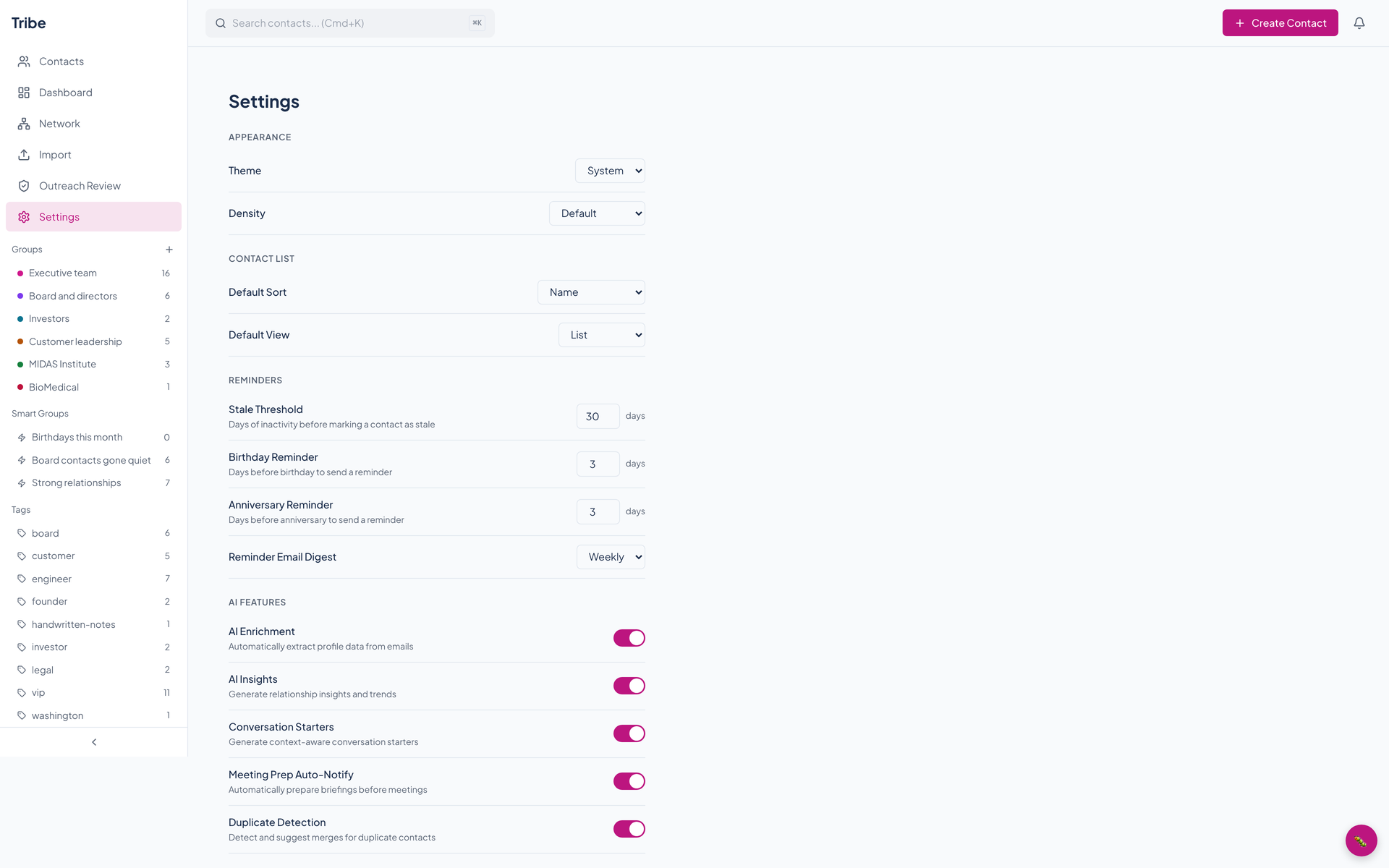
Not today. The code that would pull facts from email, suggest profile updates, write relationship insights, scan for duplicates, and send reminders is written, but the scheduled jobs that run it are placeholders, so none of it happens on its own.

Does my data go to an AI model?

Only when you ask. A conversation starter request sends a person's name, company, title, interests, and spouse details, plus when you last spoke and how strong the relationship is, to Mercury 3. A briefing request, through the API or an agent tool, sends the profile to Claude Sonnet 5.5, and the fields that Tribe encrypts are left out. Nothing else in Tribe calls a language model.

Can I bring in contacts from Google, LinkedIn, or Outlook?

Not directly. Tribe imports files: a vCard, a CSV, or an Apple Contacts database. Syncing with Google, iCloud, and Microsoft is not built (the Settings switch has nothing behind it), and there is no LinkedIn or Outlook connection.

Is there a phone app?

No. Tribe is a web app with a menu layout for narrow screens. There is no iPhone, iPad, or Mac version.

Contact

Questions about this tool?

Write to Renkara Media Group and a person will answer.